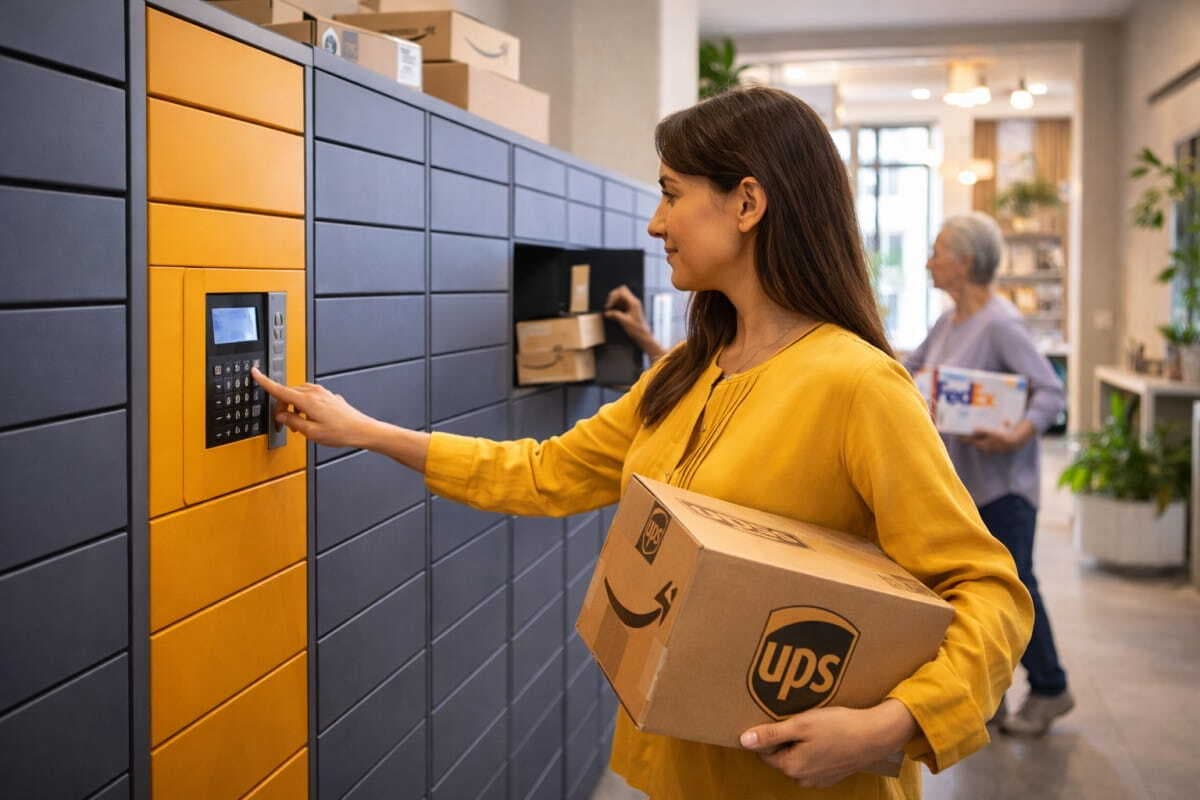
Delivered parcel lockers (and other secure pickup options) are becoming a practical “default” for city living. The majority of package recipients across the USA are constantly dealing with package theft, missing packages, or the classic “delivered” scan followed by… nothing.
A recent USPS Office of Inspector General (OIG) report estimates at least 58 million packages were stolen in 2024, with losses reported as high as $16 billion.
Let’s go in-depth into the landscape of delivered parcel lockers in Los Angeles, San Francisco, Houston, Chicago, Seattle, Dallas, Austin, Washington DC, Miami, Boston, Denver supported by statistics, city-specific insights, pricing structures, and practical comparisons, plus when a dedicated package receiving service like Stowfly can be a better alternative.
What “Delivered Parcel Lockers” actually are
Delivered parcel lockers are secure, compartment-style lockers where carriers drop packages. You retrieve them using a code, barcode, app, or building access system. They come in three common forms:
1.Retail pickup lockers (public network)
- Example: Amazon Locker / Hub Counter (typically Amazon-only orders).
- Often placed in groceries, pharmacies, convenience stores.
2.Carrier hold/pickup networks
- UPS Access Point locations and UPS My Choice delivery controls.
- FedEx Hold at Location and FedEx Delivery Manager options.
3.Building lockers (private)
- Installed in apartment buildings, offices, condos, or mailrooms; can accept multiple carriers depending on the system.
Why they help: they reduce doorstep exposure time, the window when porch pirates strike.
Why Delivered Parcel Lockers Matter More Than Ever
Across the U.S., the pain tends to fall into a few buckets:
- Porch piracy / package theft (packages stolen after delivery).
- Misdeliveries (wrong address, wrong building, wrong mailroom).
- Scan integrity issues (marked delivered early, delivered later… or not).
- Multi-unit building failure points (lobby piles, unlocked vestibules, tailgating).
- Carrier-network complexity (USPS, Amazon Logistics, UPS, FedEx each have different rules, claims, and scanning practices).
The USPS OIG notes that package theft erodes trust and creates operational burden through claims and replacements.
Meanwhile, consumers frequently report:
Consumer research also continues to spotlight porch piracy as a widespread concern nationwide.
This environment has accelerated adoption of secure parcel lockers.
For a deeper look at how lockers work and when they make sense, check out our complete guide to package lockers
What Users Usually Pay for Delivered Parcel Lockers
Many locker/pickup options are free for the recipient, but some delivered parcel lockers “change delivery” features can introduce fees depending on the carrier, shipment eligibility, and shipper restrictions.
Common costs you may see
- Amazon Locker: Generally no added fee to use for customers (you still pay normal shipping/Prime as usual).
- UPS Access Point / UPS My Choice: UPS promotes My Choice as free to join and Access Point pickup as a convenience option. Some delivery changes may involve additional fees/charges depending on service selection.
- FedEx Hold at Location: Offered as a delivery option that retailers can provide at checkout; details vary by merchant and shipment eligibility.
- USPS PO Box (secure mail + many parcels): USPS publishes PO Box pricing by “fee group,” size, and term. For 6-month terms, published prices range roughly from $20–$553 depending on location/size; for 12-month terms, published prices range roughly from $21–$339 depending on location/size.
Delivered Parcel Locker vs Alternatives: Comparison Table
Option |
Best for |
Typical user cost
|
Pros |
Cons |
Amazon Locker / Hub Counter |
Preventing Amazon missing packages and porch theft for Amazon orders |
$0 added |
Secure pickup, convenient locations |
Usually limited to Amazon orders; pickup time window |
UPS Access Point + UPS My Choice |
Avoiding UPS lost packages and missed deliveries |
Often $0 for basic pickup; some delivery changes can carry fees |
Many neighborhood locations; better control |
Eligibility varies; shipper can restrict changes
|
FedEx Hold at Location |
Avoiding fedex stolen packages at home |
Often $0 depending on merchant/shipment |
Secure staffed pickup |
Not every shipment eligible; fewer locations in some neighborhoods |
USPS PO Box |
Reducing USPS missing packages + mail theft risk | Paid (varies by location/size/term) |
Very secure, stable address |
Requires trips; not all carriers deliver to PO Boxes |
Building-installed parcel lockers |
High-volume apartments/condos |
Usually included in rent/HOA or building fees |
Multi-carrier (depending), near home |
Still vulnerable if access control is weak or mailroom is chaotic |
Dedicated package receiving service (e.g., Stowfly) |
High-risk neighborhoods, frequent deliveries, travelers |
Varies by plan/location (request quote) | Human process + accountability; prevents “delivered but missing” scenarios |
|
When Stowfly tends to win: if your building doesn’t have a secure package receiving option, you’re dealing with frequent missing packages, or you want a staffed handoff (especially for expensive items, returns, or time-sensitive deliveries).
What to do when a package is missing (by carrier)
If it’s USPS missing packages
- Start with tracking, then use USPS Missing Mail Search if needed.
- If insured, file a USPS claim within the required window.
If it’s UPS lost packages
- File a UPS claim (shipper often has best visibility; receivers may need to contact the shipper after claim initiation).
If it’s FedEx stolen packages / missing
- FedEx provides steps for stolen/missed deliveries and claim filing.
If it’s Amazon missing packages
- In practice: check order status, delivery photo/location notes, building office/mailroom, neighbors; then report via Amazon order support flow. (Policies vary by seller/shipper and item type.)
City-Specific Insights: Delivered Parcel Lockers + Secure Package Receiving Across 12 Major Metros
Package theft patterns vary by building type, delivery density, and neighborhood layout, but the solution framework is consistent: reduce doorstep exposure, increase accountability, and control the handoff.
Below are practical, city-level locker and receiving strategies based on common risk patterns in major U.S. metros.
Los Angeles (LA)
High delivery volume + single-family homes + visible porches create extended exposure windows.
Recommended approach:
Use Amazon Locker by default for Amazon orders. For non-Amazon shipments, choose UPS Access Point, FedEx Hold at Location, or a dedicated package receiving service like Stowfly for consistent multi-carrier control.
Philadelphia (Philly)
Rowhomes, shared entryways, and open stoops create easy-access theft scenarios.
Recommended approach:
Set a value threshold rule. Electronics, sneakers, and gifts should go to delivered parcel lockers or staffed pickup. If your building lobby is unsecured, a package receiving service adds accountability.
Chicago
Chicago frequently appears in porch piracy discussions and SafeWise rankings.
Recommended approach:
Use delivered parcel lockers or carrier hold options for high-value items. In older walk-ups or high-density corridors, a staffed package receiving location reduces “delivered but missing” disputes.
San Francisco (SF)
Dense housing + high-value deliveries + open-access buildings increase risk.
Recommended approach:
Avoid doorstep delivery for expensive items. Default to delivered parcel ockers, carrier hold, or staffed package receiving. Treat “buzz and drop” buildings as high-risk environments.
Seattle
Mid-rise apartments with shared vestibules create multi-unit failure points.
Recommended approach:
Use controlled-access lockers when available. If building access is weak, carrier hold or a package receiving service provides stronger chain-of-custody protection.
Denver
Suburban-style homes + visible porch delivery patterns create predictable targets.
Recommended approach:
Do not assume quiet neighborhoods are safe. Use pickup for high-value items and during peak shopping seasons.
Dallas
Rapid apartment construction + open mailrooms increase vulnerability.
Recommended approach:
Confirm whether your building delivered parcel lockers truly restrict access. If mailrooms function as open package tables, consider off-site pickup or staffed package receiving.
Houston
High volume + heat + theft risk combine to create both damage and disappearance issues.
Recommended approach:
Pickup locations reduce exposure to both theft and weather damage. For frequent deliveries, a package receiving service provides predictable security.
Austin
Fast growth + mixed-density housing means inconsistent building security.
Recommended approach:
Adopt a rule-based system: expensive items → delivered parcel lockers or package receiving; low-risk items → home delivery if entry control is reliable.
Miami
Condos and gated communities still experience lobby theft and tailgating.
Recommended approach:
Delivered parcel lockers with audit trails or staffed receiving outperform unsecured package tables, even in “gated” buildings.
Boston
Triple-deckers and shared hallway entry points create delivery confusion.
Recommended approach:
Use pickup for irreplaceable or time-sensitive items. If mail theft is the primary issue, a USPS PO Box may help for mail-heavy households.
Washington, DC
High apartment density + heavy delivery volume increase scan integrity and handoff issues.
Recommended approach:
Use delivered parcel lockers or carrier hold for work deliveries and high-value packages. Frequent travelers benefit from staffed package receiving solutions with flexible holding.
Pattern Across All 12 Cities
Lockers reduce doorstep theft.
Carrier hold improves control.
Building security quality determines effectiveness.
Staffed receiving adds human accountability.
Hybrid strategies (lockers + receiving) provide the strongest protection in high-risk metros.
In cities with consistent missing-package issues, combining delivered parcel lockers with a secure package receiving service like Stowfly often delivers the most reliable results.
A Practical Checklist to Keep Packages Safe
If you want fewer lost packages, build a default system:
- Set a value threshold (example: anything over $75 never goes to the doorstep).
- For Amazon orders: use Amazon Locker by default.
- For UPS/FedEx: prefer Access Point / Hold at Location when eligible.
- For USPS-heavy deliveries: consider a PO Box if your route regularly has issues.
- If your building is the weak link (unsecured lobby, messy mailroom), a package receiving service like Stowfly (where available in your city/ZIP) can be the “set it and forget it” fix, because the handoff is controlled and auditable.
Stowfly’s package receiving service offers a simple solution. Our secure neighborhood locations act as an alternate delivery address, receiving and holding your parcels safely until it’s convenient for you to pick them up.
To learn more about the advantages, explore the key benefits of using a package receiving service in our detailed guide
Comparison: Delivered Parcel Lockers vs Stowfly
Feature
|
Parcel Locker | Stowfly Package Receiving |
Multi-carrier acceptance |
Sometimes |
Yes |
Human oversight |
No | Yes |
Holding duration |
Limited |
Flexible |
Holding duration |
Yes |
Yes |
Reduces package theft |
Yes |
Yes |
Reduces lost/missing issues |
Sometimes |
Strongly |
Ideal for high-risk cities |
Good |
Excellent |
Common Challenges in the Delivered Parcel Locker Industry
- Locker capacity overflow during peak season
- Carrier scanning errors
- Expired pickup windows
- Technology malfunctions
- Building access vulnerabilities
Delivered parcel lockers solve doorstep theft but do not eliminate:
- Carrier delivery errors
- USPS missing packages due to route issues
- UPS lost packages from sorting facilities
- FedEx stolen packages prior to locker drop
SWOT Analysis of Delivered Parcel Lockers
Strengths
- Reduces package theft
- Convenient self-service
- Growing urban adoption
Weaknesses
- Limited holding time
- Not universal for all carriers
- Capacity limitations
Opportunities
- Smart locker AI integration
- Expansion into suburban markets
- Hybrid locker + receiving models
Threats
- Direct-to-door secure delivery innovation
- Drone delivery systems
- Increased carrier liability reforms
Practical Considerations for Delivered Parcel Locker Users
If choosing a Delivered parcel locker security solution, consider these:
- Does it accept all carriers?
- Is there a holding limit?
- Are there hidden fees?
- Is it located conveniently?
- Is theft still possible within the building?
- Is there human accountability?
- Are there photo confirmations?
- What happens if you travel?
The Future of Delivered Parcel Locker Security
Industry growth is expected to continue as:
- E-commerce expands
- Urban density increases
- Consumers demand secure alternatives
- Package theft remains a national issue
Hybrid systems, i.e combining delivered parcel lockers in Los Angeles, Philadelphia, Chicago, San Francisco, Seattle, Denver, Dallas, Houston, Austin, Miami, Boston, and Washington DC with secure package receiving services may define the next evolution.
Final Thoughts
Delivered parcel lockers have become an essential part of modern urban logistics. They reduce exposure to package theft and significantly cut down on missing packages. However, they are not perfect.
In high-density cities such as Los Angeles, Chicago, Philadelphia, San Francisco, Seattle, Denver, Dallas, Houston, Austin, Miami, Boston, and Washington DC, residents are increasingly combining delivered parcel locker usage with secure package receiving services.
Stowfly’s secure package receiving locations offer a safer alternative delivery address, human oversight, and flexible pickup options, offering a smarter way to receive packages now!